Most colleges don't have a shortage of enquiries. Every admission season, hundreds or thousands of prospective students reach out through the website form, a phone call, WhatsApp, a walk-in visit, an education fair, or a referral agent. The shortage is somewhere else entirely — in what happens to those enquiries in the hours and days after they come in. A form submission sits unread in an inbox. A phone enquiry gets scribbled on a notepad that never leaves the front desk. A WhatsApp message goes unanswered until the counselor gets to it, which by then might be three days and one competing college later.
This is the gap an admission CRM is built to close — not by generating more enquiries, but by making sure far fewer of the enquiries a college already has slip through before they ever become an admission.
Why Most Colleges Leak Enquiries Before They Reach the Admission Office
The leak rarely happens because counselors aren't trying. It happens because the process around them isn't built to hold enquiries accountable:
- Enquiries live in too many places at once — a spreadsheet for website leads, a register for walk-ins, a counselor's personal phone for WhatsApp and calls. Nobody has one view of the full list.
- Nobody owns the follow-up. Without a clear assignment, an enquiry can sit untouched simply because everyone assumed someone else was handling it.
- Response time isn't tracked. A student who enquired at three colleges will usually respond to whichever one replies first and most helpfully — but if a college has no visibility into how fast its own team is responding, that's the first thing working against it.
- Follow-up stops after one attempt. Most enrollment decisions aren't made on the first conversation. Without a structured cadence of follow-ups, a "maybe, let me think about it" enquiry never gets revisited.
- There's no funnel visibility. Admission heads can usually say how many total enquiries came in and how many students enrolled — but not where, in between, most of them were lost.
None of this is a counselor performance problem. It's a systems problem, and it's exactly what an admission CRM is designed to fix.
What an Admission CRM Actually Does
An admission CRM isn't just a database of student contacts. Built well, it becomes the single place every enquiry — regardless of source — enters, gets tracked, and moves through until it's either enrolled or closed with a reason.
One record per prospective student, from every source
Website form submissions, phone enquiries, WhatsApp conversations, walk-ins, and referral or agent leads all land in the same system as a single, de-duplicated student record — instead of five disconnected trails that nobody can see together.
Clear ownership from the moment an enquiry arrives
Every enquiry gets assigned to a specific counselor automatically, based on rules like program interest, campus, or workload balance — so "who's following up on this?" always has an answer.
A follow-up cadence that doesn't rely on memory
Instead of one phone call and hoping the student calls back, a CRM prompts structured, multi-touch follow-up — a call, then a WhatsApp message a few days later, then an email with the brochure and fee structure — scheduled at times that actually respect when parents and students are reachable, not sent at 11 p.m. because that's when a counselor finally got to their task list.
An admission-specific pipeline, not a generic sales pipeline
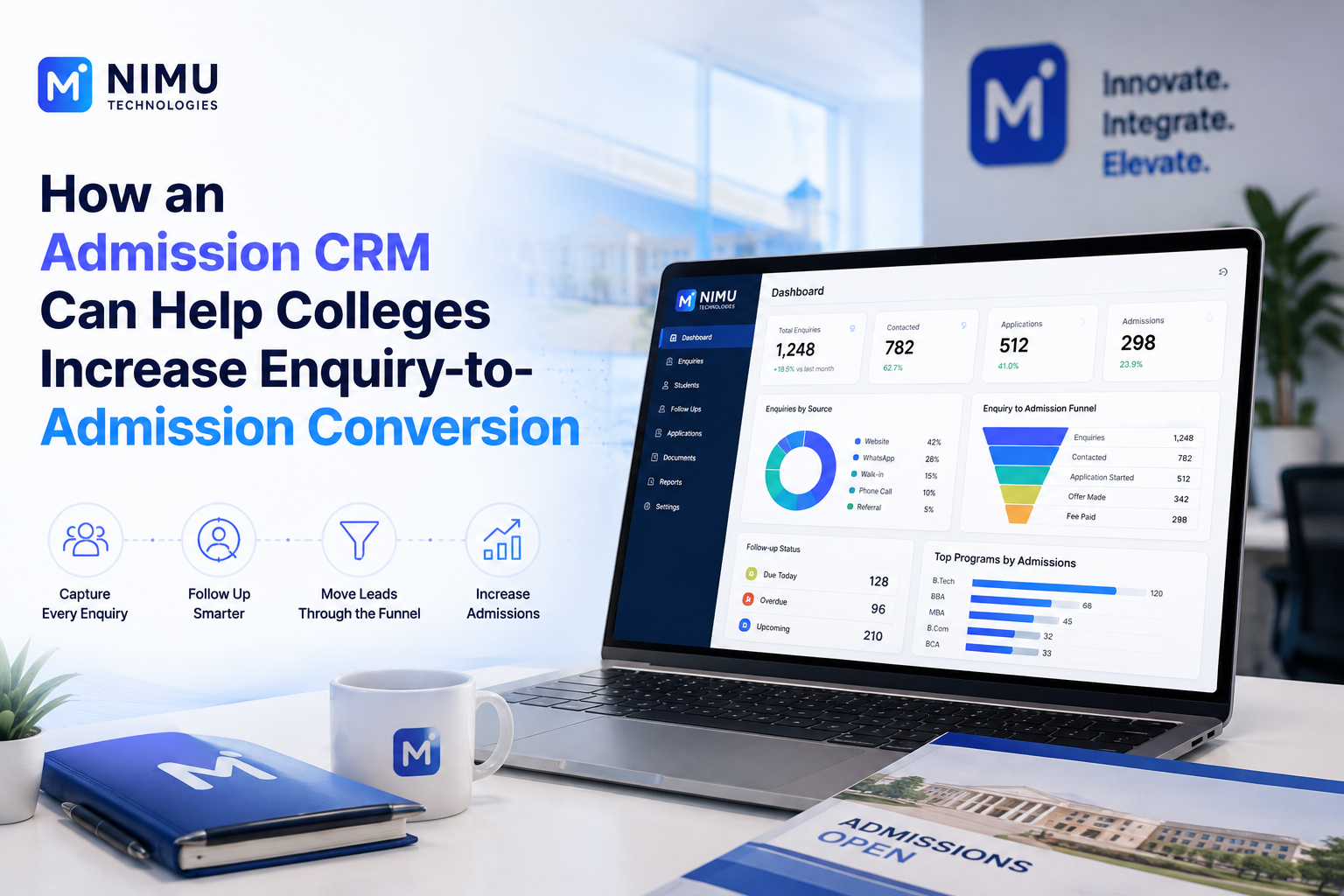
Enquiry → Contacted → Application Started → Documents Submitted → Offer Made → Fee Paid → Enrolled. Every student sits at a defined stage, so the admission office can see exactly how many are at each point of the funnel at any moment — not just an enquiry count and a final enrollment count with nothing in between.
Reporting that shows where enquiries are actually being lost
Which source produces enquiries that convert versus enquiries that go nowhere. Which counselor's follow-up cadence is working. Which program has a strong enquiry volume but a weak conversion rate, and at which stage students are dropping off. That's the data that turns "we need more leads" into "we need to fix the follow-up gap between enquiry and application."
Where Colleges Actually Lose Conversions in the Funnel
Enquiry-to-admission conversion doesn't fail at one point — it leaks gradually, and each stage needs a different fix:
- Enquiry to first contact. The single biggest lever. A student comparing colleges will engage with whoever responds first, clearly, and with the specific information they asked for — not a generic brochure three days later.
- First contact to genuine interest. This is where a single missed follow-up costs the most. Most students need two, three, or more conversations before they seriously consider a college — and without a system prompting the next one, it simply doesn't happen.
- Interest to application started. Friction here is often practical, not emotional — an application process that's confusing, a document requirement nobody explained clearly, or simply nobody following up to ask if the student needs help finishing it.
- Application to enrollment. Even accepted students can be lost here if fee deadlines, document submission, and confirmation steps aren't actively tracked and reminded — especially against a competing offer from another institution.
An admission CRM doesn't just track that these stages exist — it makes each one visible enough that the admission team can act on a stalled student before that student quietly enrolls somewhere else.
Capabilities That Actually Move the Conversion Number
WhatsApp as a primary channel, not an afterthought
For most Indian college admissions, WhatsApp gets read and replied to faster than email — and often faster than a phone call gets picked up. A CRM that treats WhatsApp as a first-class communication channel, with templated follow-ups and reminders, meets students and parents where they're actually paying attention.
Business-hours-aware scheduling
Enquiry follow-up sent at a sensible hour gets read; the same message sent at midnight gets ignored or, worse, creates a poor first impression of the institution. Scheduling follow-up calls, WhatsApp messages, and emails within reasonable hours — and prompting the next one automatically — keeps the cadence going without anyone having to remember to do it manually.
Counselor accountability without micromanagement
A shared, visible pipeline means an admission head doesn't need to ask each counselor for a status update — the system already shows who's been contacted, who's overdue for follow-up, and who's been sitting untouched for a week.
Application and document tracking
Once a student applies, the CRM tracks exactly where the file stands — documents pending, fee status, offer sent — so nobody has to chase that information across email threads and physical files during the busiest weeks of the admission cycle.
Multi-campus and multi-program visibility
For institutions running more than one campus or program, a CRM gives leadership a single, comparable view across all of them — instead of stitching together separate spreadsheets from each department at the end of the season.
What to Look for When Evaluating an Admission CRM
- An admissions-specific pipeline out of the box — not a generic sales CRM repurposed with a few relabeled fields.
- Native WhatsApp and SMS support, since those are the channels students and parents actually respond on.
- Role-based access — counselors see their own enquiries, admission heads see everything, without extra configuration work.
- Integration with your website's enquiry form, so leads land directly in the CRM instead of an inbox someone has to manually re-enter.
- Real reporting — funnel-stage and source-wise conversion, not just a total enquiry count.
- Data security for student information, given the volume of personal data — names, contact details, academic records — an admission office handles every season.
A Realistic Way to Start
- Pull last season's enquiry and enrollment numbers, even if they're scattered across spreadsheets — that gap is your baseline conversion rate.
- Identify the one stage where you already suspect the biggest drop-off happens — first contact, follow-up, or application completion.
- Look for a CRM built around an admissions pipeline specifically, rather than adapting a generic sales tool built for a different kind of business.
- Start with a single intake cycle or campus before rolling it out institution-wide, so counselors and admission staff can adjust to the new process without the pressure of peak season.
This is also where a purpose-built education platform or a custom CRM tends to outperform an off-the-shelf sales tool retrofitted for admissions — the pipeline, the follow-up cadence, and the reporting are shaped around how enrollment decisions actually get made, not adapted after the fact.
The Bottom Line
Colleges rarely need more enquiries as much as they need fewer of their existing enquiries to go cold. An admission CRM doesn't replace counselors — it gives them a system that remembers every enquiry, prompts the next follow-up at the right time, and gives admission leadership visibility into exactly where the funnel is leaking. That combination is usually worth more to enquiry-to-admission conversion than any additional marketing spend.
If your college is evaluating how a CRM could fit your admission process, that's a conversation worth having well before the next intake cycle begins.