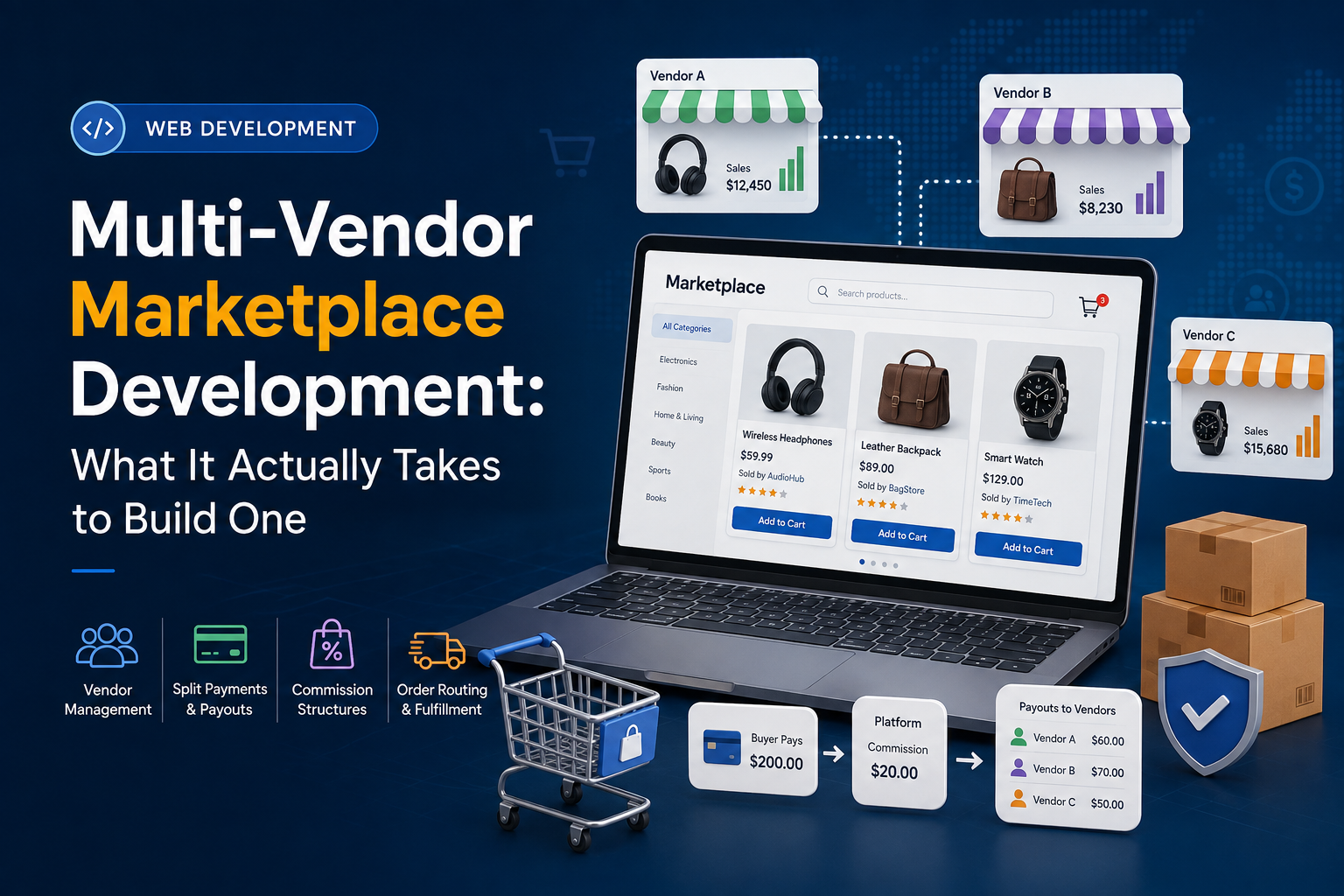
Most requests for a "marketplace" start from the same place: an existing e-commerce store, plus the idea that other sellers could list their own products through it. That framing undersells what's actually different. A marketplace isn't a store with more inventory — it's a different kind of application, with money, trust, and inventory flowing through parties who don't work for you.
Why a Marketplace Isn't Just a Store With More Sellers
A single-vendor store has one party responsible for every order: pricing, stock, fulfillment, and payment. A marketplace splits every one of those across multiple independent sellers, while the platform still has to present a single, trustworthy checkout experience to the buyer. That split is where most of the real engineering work lives — not in the product listing pages, which look almost identical to a normal store.
The Parts That Actually Make a Marketplace Work
Vendor onboarding and management
Every seller needs their own dashboard — for listings, orders, and payouts — along with an approval and verification step before they can start selling. This is effectively a second application living inside the first one.
Split payments and payouts
A buyer pays once; that payment then needs to be split between the platform's commission and each seller's share, and paid out on a schedule the seller can rely on. This is usually built on a payment gateway's marketplace or connected-accounts product rather than from scratch — getting payout timing and reconciliation wrong is a fast way to lose seller trust.
Commission and fee structures
Flat percentage, tiered by volume, category-specific — the commission model needs to be configurable, not hardcoded, because it's one of the first things that changes as the business negotiates with different types of sellers.
Order routing and fulfillment
A single cart can contain items from several sellers, which usually means splitting one order into several sub-orders behind the scenes, each with its own status, shipping, and communication — while the buyer still sees one coherent order.
Where Marketplaces Actually Get Complicated
- Inventory that isn't yours to control — sellers update their own stock, on their own schedule, and the platform has to handle overselling gracefully when two buyers order the last unit at once.
- Trust and dispute resolution — returns, refunds, and quality disputes now involve three parties instead of two, and someone has to arbitrate.
- Search and discovery across many sellers — ranking listings fairly when sellers vary widely in quality, stock accuracy, and fulfillment speed is a real design problem, not just a database query.
- Seller-side reporting — sellers will ask for their own sales data, and building that well is most of a second product.
Marketplace-in-a-Box vs. Custom Build
Platforms like Sharetribe or Arcadier exist specifically to shortcut this — and for a straightforward marketplace with standard commission and payout needs, they can be the faster, cheaper path. The case for a custom build usually comes down to one of a few things: a commission or payout structure the off-the-shelf platform doesn't support, deep integration with systems you already run, or scale that pushes past what a hosted platform's infrastructure was designed for.
A Realistic Way to Start
- Define the commission and payout model on paper before writing any code — it's the piece hardest to retrofit later.
- Decide who owns inventory accuracy: the seller, the platform, or a hybrid — this shapes the entire product data model.
- Map out what happens on a return or dispute involving all three parties, before a real one happens.
- Evaluate a marketplace-in-a-box platform honestly before assuming a custom build is necessary.
The e-commerce development work — storefront, catalogue, checkout — is the part that looks familiar. The marketplace-specific work — vendor management, split payments, multi-seller order routing — is where the actual project lives.
The Bottom Line
A multi-vendor marketplace is a legitimately different build from a single-vendor store, not a bigger version of one. The complexity is concentrated in vendor operations, payments, and trust — not in the parts of the site that look like a normal storefront. Scoping those pieces honestly before development starts is what keeps a marketplace project from doubling in size halfway through.
If you're evaluating whether your marketplace idea needs a custom build or fits an existing platform, that's a conversation worth having with the actual commission and payout model on the table, not just a feature list.